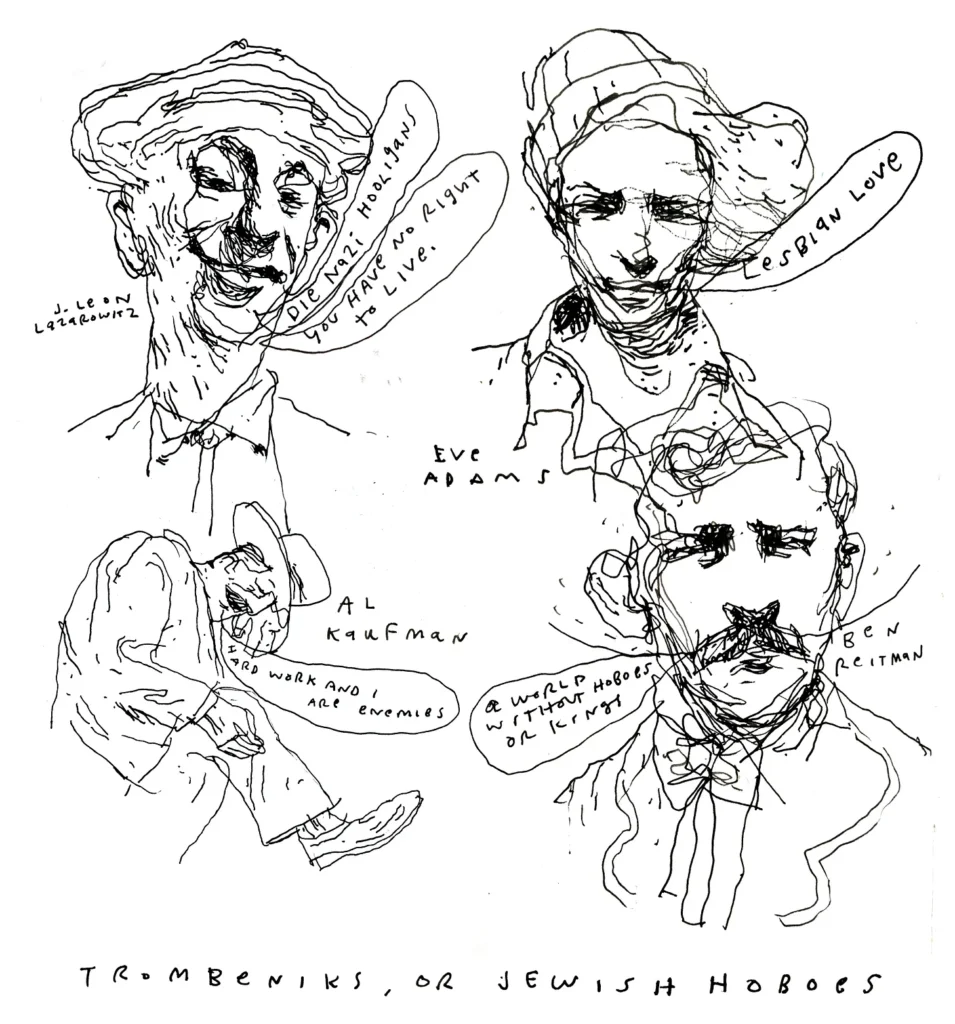
“Hard work and I are enemies.” – Al Kaufman
The hoboes, tramps and bums who traveled throughout America and beyond in the early 20th century did so for many different reasons. Some, like Al Kaufman, hated work. But many others were desperately looking for work. Some hated their options, or their partners or their town and decided to hit the road and roll the dice. Like today’s unhoused people, the cruel irony is that most ended up working like hell just to survive.
The Jewish hobo from that time was too dissimilar, although a fascinating early account of them does point to some interesting variations.1
The Jewish tramp will take refuge in metaphysics or “riddles,” as he calls it, break up a game of dice to which he is not adapted, and start a poker game…
Who knows? They were rare, but prominent, and left a lasting legacy in culture and politics. Here are four of them.
Ben Reitman, the Anarchist Hobo
Reitman (1879–1943) hit the road around age 12, and claimed to have tramped all over the US and overseas before settling down in Chicago with the aim to get a medical degree. Amazingly, he did. After managing to get the degree, he didn’t abandon his previous life, but instead provided medical care to the poor and outcasts of society. He performed abortion services at a time when reproductive services were rare and advocated for honest and open sexual health care. For his troubles, he was beaten severely and jailed. He was well known as the romantic partner of the anarchist Emma Goldman, who he was with for about a decade, and with whom he traveled widely. Reitman’s relationship to Judaism was complex and troubled. He appears to have converted to Christianity at one point, although it didn’t appear to last long. To the end, he was far from anti-work. His professional and creative work seemed endless. However, at various intervals in his life, he would occasionally hang up his stethoscope and hit the road, which seemed to continually call to him throughout his life.
Al Kaufman, the Anti-Work Hobo
“Don’t paint him as a RADICAL or intellectual, Al Kaufman is a charming playboy.” – B. Reitman
Unlike Reitman, Al Kaufman hated work. He tried it here and there, but decided it just wasn’t for him. How did he live? In his own words, “I got by.” He once sold a car without an engine. Like other hobos, he traveled widely, including overseas. “The type of hobo you represent, and which you are a worthy leader, is the poetic, rambling man of leisure who takes life and anything else easy and avoids all responsibility and attachment.” Ben Reitman said that, which is ironic because Reitman wrote poetry and Al didn’t. He wasn’t interested in abstractions- too much work! Al did leave behind a witty memoir however, and in it he briefly touches on his Jewish background, “Some [Jews] get melancholy and feel inferior. I don’t.” He didn’t shy away from Judaism but neither did he dwell on it too much. He recounts one adventure where he organized a small group to beat up nazis in Toronto. Give him credit- Kaufman was anti-work until the end. The closest he came to disloyalty was when he fell in love with his Marie, “I’d have even worked for her, I was that nuts.” But in the end, his hunger for the road won out. As he said, “A guy can’t have everything.”
Leon Lazarowitz, the Hebrew Hobo
“Doctor of Gratis Touring, Esq.,Old Time Hobo, Private American Citizen, Professor of Milestone Inspection, World Champion Hebrew Hobo, Chief Justice Supreme Hobo Kangaroo Court, President of Rambling Hoboes, Doctor of Migratory Lit., Gentleman of The High Road.”
That is how Leon Lazarowitz described himself. Unlike the two previous tramps, Lazarowitz’s Judaism was an important part of how he identified himself, “He also wanted it known that he alone, of all the hoboes, does not travel on the Sabbath , and always carries with him his talith and tefilim.” Of all four hoboes, Lazarowitz was the only one to not leave behind some form of biography, but his charming character generated lots of interest in the American and Canadian press. When Roosevelt reduced the workweek, Lazarowitz said the hobos would show their approval by only traveling 5 days a week. Wary of crowds, he would travel north in winter and south in summer. He wrote Hitler telling him “You nazi hooligans have no right to live. Do us American hobos a favor and die. We hate you and your kind.” He quit his leadership position in the Hobo Union because they wouldn’t denounce the nazis and eventually joined the Canadian army to fight in WWII.
Eve Adams, The Activist “Hoboette”
Eve was a short red-headed Jew girl,
Born in russia 25 yrs ago,
She has a pale freckled masculine face
With an ambitious nose and restless chin.
She got tired of the New York factory life & decided to tramp around the country
She worked like hell & saved her money until she found some female of the right type,
Then she should lavish presents & affections upon her.
She traveled around the country in search of types,
And had about 20 affairs with the ladies
She said “Why do you object? What harm am I doing?”
This was a curious poem I ran across in Ben Reitman’s unpublished archives. While the overwhelming majority of hoboes were men, there were some women. Reitman himself had hinted as much elsewhere but said they were reluctant to tell their stories. Amazingly, the “Eve” in the poem turned out to be a real person- Eve Adams (1891-1943). She was a trailblazing lesbian activist who established a gay and lesbian teahouse in NYC and wrote a groundbreaking book, Lesbian Love. Her sexuality and politics made her a target and she was arrested, jailed and ultimately deported. Adams was sent back to Poland in 1927 where she was eventually murdered by the nazis.
—
Why did three out of the four write accounts of their lives? What were the hoboes trying to tell us? Both Reitman, in his unpublished poems, Outcast Narratives2, and Adams, in Lesbian Love, also focused on a literary form composed of short biographical portraits of other marginal folks, provided without much editorial comment. This form is essentially the one that Allen Ginsberg would use a couple generations later in Howl.3 Ginsberg shrunk his biographical portraits into shorter, denser, even more explosive units, but the model is essentially the same. The form seems to insist on the primacy of the human in a world being torn and twisted by inhuman forces. It doesn’t require comment, as much as witnessing. As he liked to say, “Candor ends paranoia.” Those who do not or cannot relent to those inhuman forces, who insist on their humanity, will need to find each other in every generation. Good luck!
For More Reading: Ben Reitman’s Sister of the Road: The Autobiography of Boxcar Bertha is a famous hobo text, quite possibly a veiled portrait of Reitman himself, and also emphasizes his unique focus on gender. Al Kaufman’s I Got By is a wry memoir that gives a good taste of the “bum” life. The Daring Life and Dangerous Times of Eve Adams by Jonathan Ned Katz is a brilliant recent biography and includes the complete text of Adams’ Lesbian Love. Google “Leon Lazarowitz hobo” for countless articles in newspaper archives detailing his many exploits.
This article is reproduced from Phil Blank’s Substack Psychic Courtyardism, which is well worth a visit!