Background
In an attempt to understand how Western Civilization tried to explain subjective experience, you could draw a very oversimplified picture that goes something like:
Religion (pre-Early Modern)—> Heresy (17th/18th century) —> Art (19th/20th)
I’ve been curious about how nocturnalization, or the changing role of night, lingers behind this trajectory. This idea, not mine, is that in the Early Modern Period, Europeans started to “shape” night to their own uses, which lead to huge cultural and political shifts. My own teeny contribution is to wonder about the connection of this to earlier moments in Jewish and Sufi history which made special use of coffee and tobacco, and which contributed to heretical movements.
For most of my readers, we take these night-time experiences and ways of being, ranging from the calm to ecstatic, for granted. This has been the way society was structured for over two hundred years. But it’s quickly fading. I put the end of this “Age of Night” sometime around 2009, when the first algorithm appeared on Facebook. Coincidentally, these algorithms popped up a couple years after cigarettes were strongly discouraged in the U.S. (A good thing- don’t misunderstand me!). It’s now obvious people use algorithms the exact same way they used tobacco. However, algorithms conjure a different space and time- they are “always on” and they’ve changed our relationship to night irreparably. We are entering a new relationship to nocturnalization where night no longer feels or acts the same.
Nerves
One key to understanding the shift from the religious to the secular is nerves. This wonderfully vague quasi-scientific idea first appeared in the 19th century. “Nerves” negotiate the border between our internal and external worlds and if your nerves are not tuned right, you may suffer from various ailments, including melancholy which also appears prominently at this same juncture, or who knows, you may be a musician or an artist or inappropriately feminine or something. I did a painting about this internal/external dynamic,
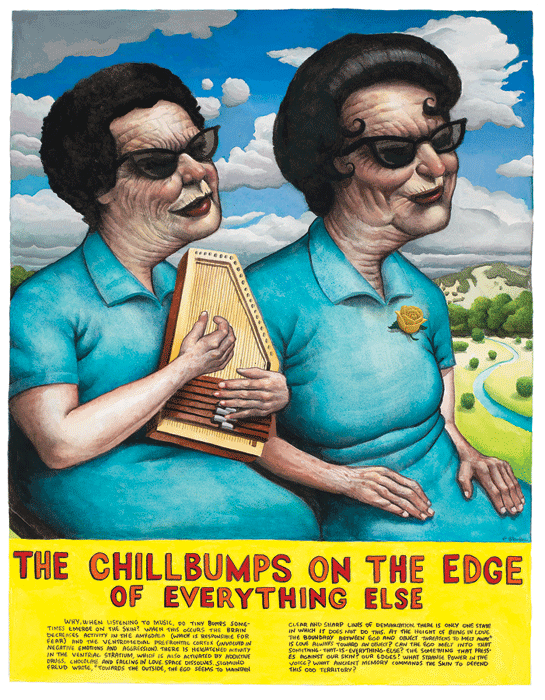
Anyway, it’s a perfectly nutty metaphor. Completely crazy in its own way, but no more than any of the other ways we’ve tried to explain subjective experience. Once we understand the idea of nerves, the role of coffee and cigarettes becomes obvious. Music also crosses this physical/psychological barrier. What follows are some delightful and weird musical pieces that paint a picture of how these two substances and the new understanding of nerves were all wrapped up at this crossroads of history. The world they created is an important part of who many of us are today, as much as any national or religious identity I’d argue. This isn’t meant to prove anything, and for goddess’ sake, don’t smoke that cigarette, but enjoy the history and let its aroma calm (or agitate) your nerves.
This is from a five-part madrigal by Michael East, published in 1606…
O Metaphysical Tobacco,
Fetched as far as from Morocco,
Thy searching fume exhales the rheum.
From Tobacco and Coffee in Music, a great article where I stole many of these from. Sheet music.
Bach’s Kaffee Kantata (1732-1735). See gender, nerves and secularity.
Captain Tobias Hume’s Ayres; “Tobacco is like love…” (1605ish)
J’ai Du Bon Tobac (1733). A popular French kids song, even today (see versions on Youtube).
In all the lexicons, in all the dictionaries,
there is no finer word than tobacco.
That word eases my heart,
and its soothing charm makes many long days and nights pass quickly.
The Smoak that does so high ascend,
Shews you Man’s Life must have an end;
The Vapour’s gone;
Man’s Life is done,
Think of this and take Tobacco.
There’s some debate about the last line. Is it a cautionary tale against tobacco (think of this when you take tobacco) or a declaration of how tobacco can ease existential dread (think of this and take tobacco). However in many of these and other poems from the time, these magical substances, who were able to cross the inside/outside divide was seen as part of mysteries of subjectivity itself.
Fill the pipe once more,
My brains dance trenchmore [a lively dance],
It is heady
I am giddy,
My head and brains,
Back and reins [kidneys],
Joints and veins,
From all pains
It doth well purge and make clean.
This article is taken from Phil Blank’s remarkable Substack, Psychic Courtyardism.
The Illustration is believed to be the earliest illustration of the interior of a coffee house. CC.