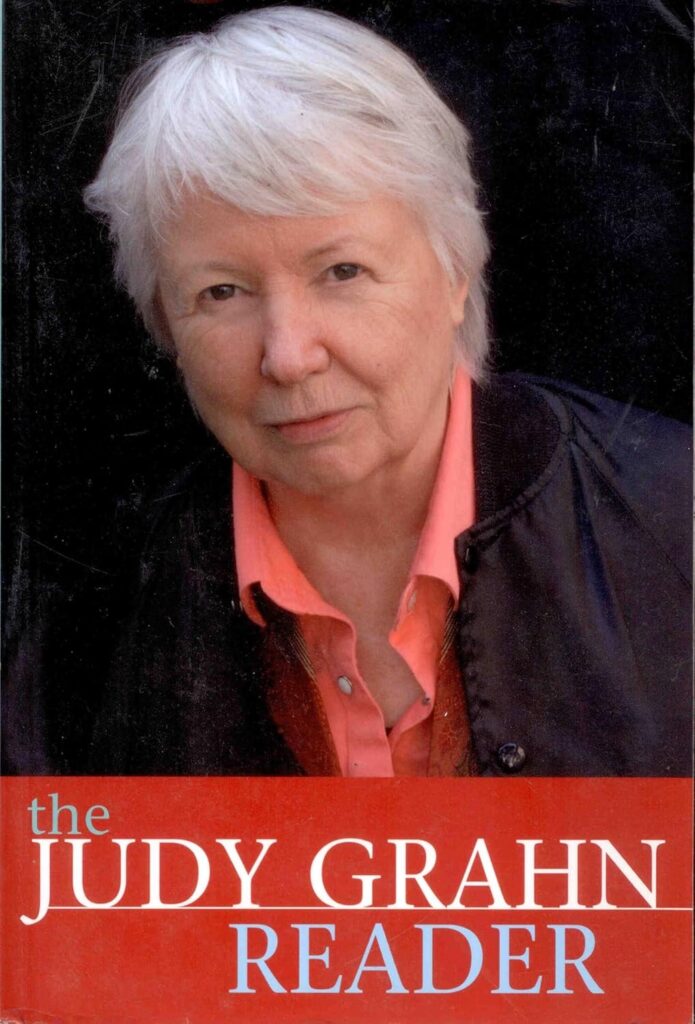
Judy Grahn’s magnificent The Queen of Wands is long out of print, though second-hand copies are available still, and very inexpensively. We would however suggest The Judy Grahn Reader, which contains most of the the Helen poems discussed here, and a brilliant selection of Grahn’s work. Please consider following the link here to buy directly from the storied Aunt Lute Books, so as to give them the full benefit of your patronage.
Icannot endorse the canon of 20th century poets: how could one? In every other age, the most admired have been the soonest forgotten. The Nineteenth century placed Longfellow, Whittier and Bryant at the center of their poetic pantheon—who reads, or even remembers them today? More than a century later, when the smog of popular opinion has dissipated, Whitman and Dickinson emerge as the real heroes of the age. We, overall, are no wiser than our grandsires.
I shall not here take aim at the whole Norton anthology: my interest lies in poetry by women. But the same historically founded scepticism may apply to the supposed greats there. I don’t think that highly of Edna Millay or even Amy Lowell. They wrote in a time when women were very concerned to show that they could write as well as men—which they understood to mean writing in the manner of men. The results were as disappointing as Robert Burns’ poems in standard English, and for exactly the same reason. Loss of native idiom entails a loss of authenticity.
The twentieth century was half over before American women wrote in their own voices. Yet even here, critical judgement was skewed by popular prejudice. Sylvia Plath and Anne Sexton have pride of place, not because of their genuine merits—which are considerable—but because their lives aligned with the male expectation that a woman who got a college education would go mad and end badly. But the very substantial merit of these authors is vitiated for me, not because of the male misapprehension, but because I don’t find self-chosen misery that interesting.
The most serious contender for own-voiced woman poet laureate is probably Adrienne Rich—or would have been, had she not repudiated her earlier artistry in favor of politics. Her finest book, to my mind, her 1955 The Diamond Cutters—which she herself was ”tempted to delete” as she turned to facing “the hard questions.” Rich’s turn from poetry to social sermonizing was an infinite loss to American poetry.
The women poets I most admire are, like Whitman and Dickinson, unknown or marginalized: (mentioning here only the Americans) Margot Farrington, Deborah Gorlin, Anne Myles, Julia Vinograd and Judy Grahn. It is of Grahn I mean to speak in this essay.
Grahn might be easily dismissed for her excursions in feminist pseudo-history, and her obsessive insistence that menstruation is the fountain-origin of civilization. But extraordinary opinions are often the price of extraordinary insights. Grahn wrote a number of poems of extraordinary power and value, whatever strange paths led to them.
The poems of The Common Woman were justly famed in their time, I recall posters in radical bookstores in the seventies which quoted the poems’ finale,
the common woman is as common
as good bread
as common as when you couldnt go on
but did.
For all the world we didnt know we held in common
all along
the common woman is as common as the best of bread
and will rise
and will become strong — I swear it to you
I swear it to you on my own head
I swear it to you on my common
woman’s
head
—lines which rank with Carolyn Kizer’s Pro Femina or Elma Mitchell’s Thoughts after Ruskin in their anthem-like grandeur.
The Common Woman is the feminist counterpart to the Prologue of the Canterbury Tales. It is a gallery of women, unmistakably drawn from life. Helen the businesswoman,
Wearing trim suits and spike heels,
she says “bust” instead of breast;
somewhere underneath she
misses love and trust, but she feels
that spite and malice are the
prices of success. She doesn’t realize
yet, that she’s missed success, also,
so her smile is sometimes still
genuine. After a while she’ll be a real
killer, bitter and more wily, better at
pitting the men against each other
and getting the other women fired.
She constantly conspires.
Her grief expresses itself in fits of fury
over details, details take the place of meaning,
money takes the place of life.
Ella the waitress,
Once,
she shot a lover who misused her child.
Before she got out of jail, the courts had pounced
and given the child away. Like some isolated lake,
her flat blue eyes take care of their own stark
bottoms.
Margaret the housewife,
At her last job she was fired for making
strikes, and talking out of turn;
now she stays home, a little blue around the edges.
Counting calories and staring at the empty
magazine pages, she hates her shape
and calls herself overweight.
Her husband calls her a big baboon.
Lusting for changes, she laughs through her
teeth, and wanders from room to room.
The common woman is as solemn as a monkey
or a new moon.
These characters are realer than real, they remind us that once poetry did what novels then movies came to do: it preserved the most authentic and vivid record of actual lived experience. Poetry as truest history.
Grahn also has the true lyric gift. Lyric means song, and the power of song is to express in fewest words, sweet in their simplicity, a psychological situation, as in thiese lines from The Common Woman,
She has taken a woman lover
whatever shall we do
she has taken a woman lover
how lucky it wasn’t you
These lines capture the delighted dismay of the gossip, but in an ironic sing-song which expresses the defiance of the lesbian who is here recounting what other women are saying. This is what lyric poetry does at its best: presents a whole hurting drama in a stanza.
Grahn’s “Carol and” is a playful lesbian potrait which brings this kind of lyrical concentration of expression to a fever pitch; a few lines will give some notion of its witty precision,
Carol and her
hard glance
stiff dance
clean pants
bad ass
lumberjack’s
wood ax
Carol and her
big son
shot gun
lot done
Grahn’s masterpiece is her cycle of Helen poems from her 1982 book The Queen of Wands. These include a retelling of the Helen of Troy story, which achieves the miracle of making fresh these stalest of tales,
In ships he came to me,
In ships surrounded.
I was dumbfounded.
A thousand ships, so many!
where had he gotten them?
They filled the harbor
like a bobbing forest.
I was almost proud;
I stood on the ramparts of the city
and exclaimed out loud.
None of us knew the war would
last so long
and be so boring.
None of us knew we women were already
in prison. We sat in the weaving room
month on month, winding the distaff,
working the shuttle,
with only our own housebound pratttle,
with never anything frest, not air
or news or love or food.
The first of these stanza’s is great lyric: the characterization of the masts as a bobbing forest, and the revelatory psychological ambivalence of I was almost proud.
The next stanza brings a feminist politics into the history, which works because it is show not tell, and illumines the past with genuine present day experience: “Woman’s work” defined by confinement and monotony. Though I am leery of political art—propaganda can never be poetry—a political dimension can be a powerful element in artistic expression so long as it describes life rather than prescribing to life.
There is more. The whole six page poem is a perfect mini-epic, in which the the epic narrative is shot through with chilling insight into women’s embattled existence in a patriarchal world. In less skilled hands this could have ended badly, and it would be well understandable if it had. The Greek mythology regards rape with a casual indifference, as an indispensable plot device. The concept of woman as property is the very roof-tree of the Iliad.
Grahn’s retelling of the legend deploys feminist critique with a lofty aesthetic sense and dignified measure which can only be called classical—what Adrienne Rich calls high restraining purity. Thus Grahn becomes a worthy link in the cultural tradition that connects us to Homer as it does to Sappho. She is is true dialogue with ancient greatness, which she addresses and understands as an equal.
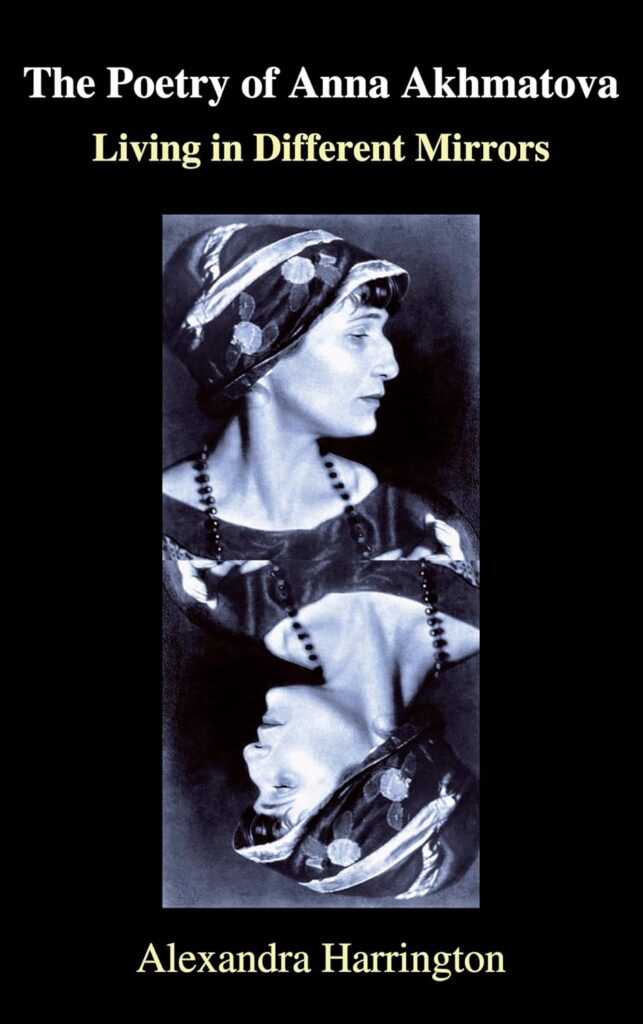
The Poetry of Anna Akhmatova, Living in Different Mirrors, Alexandra Harrington, Anthem Press 2006.
Finding a good study of Akhmatova is nearly impossible. What can one expect, when even an adequate translation is unattainable? For the English translations of Akhmatova are appalling. The standard, Judith Hemschemeyer 1997 Complete Poems is so cryptically literal as to be generally unintelligible. Her successors have not improved upon her performance.
Akhmatova’s place in the pantheon, for the anglophone reader, never depended on real appreciation of her achievement. As was usual in 20th century, politics took the place of taste. Akhmatova was prized because she was a stick to beat the Soviets with. Yes, Hemschemeyer’s massy tome sold, as to some extent did the productions of her competitors. Whether they were actually read, or just put on display to give the owner intellectual cred, is another matter.
The Akhmatova biographies in English—Feinstein, Reeder, Haight—are similarly disappointing. The poetry isn’t understood, so the lit-crit that occupies the bulk of the books is just filler. Nor do these treatments give adequate historical context. One will understand Akhmatova better by reading the excellent histories of Russia by Orlando Figes or undeservedly forgotten W. Bruce Lincoln than by dredging the Akhmatova bios for the odd helpful fact.
Harrington’s study of Akhmatova is the first we’ve seen that actually offer insights.
The biographical sketch in the the introduction is the most able and concise survey we know of Akhmatova’s career, which falls into three phases. The lyrical modernism of her first five books, her silencing by Stalinist repression from 1925-1940 when she turned to scholarship and translation to avoid politics, and her final, post-modern period, when she produced masterpieces which could not be published until after her death. The outline Harrison provides may not seem like a great achievement, but one will search in vain for anything like this lucid mastery of facts elsewhere. Great Slavic scholars all know the facts as Harrison presents them. But they never offer them—because they assume everyone else already knows them too.
Haight sees the early Akhmatova poetry as a modernist, and her later work as postmodernist. Her analysis of these movements is subtle; for the convenience of the reader, I will attempt a far simpler description.
Modernism was a reaction to the self-referential, closed system of western art that had developed since the renaissance. Its intellectual infrastucture was neoplatonism. Plots for novels, subjects for paintings, images for poems, had all become formulaic, and were too well entrenched to allow new forms to displace them—though the modern industrial world had made the old aesthetic orthodoxy irrelevant.
I will offer one example from the visual arts. A historical general on horseback could no longer be viewed as a noble, or even a particularly interesting subject for a painting. The Impressionists were the first choose unprecedented subjects and styles, and to the world anew.
Modernists rejected the past wholesale in favor of a direct encounter with experience, opening the floodgates to modern reality, without filter. This yielded stream of consciousness writing, painting that embraced the raw energy of barely altered color and form, music that forsook tonality. Akhmatova was, despite her classical form and clarity, a modernist, in that she drew on uncensored depths of personal experience for her poetry, in a way that had thus far only been done in naturalist novels.
Akhmatova was part of the Acmeist movement (roughly analagous to the Imagist movement in English language poetry) which defined itself against Symbolism (which was dominant from about 1890 to 1910). The Symbolists were in fact reactionaries, trying to make the old cultural formulae work by distilling them into an ever more potent brew, fortified by a generous admixture of sex and occultism. Baudelaire and Rimbaud are the instances of this trend most familiar to American readers.
In chapter one, Harrison’s quotes the Acmeist critique of Symbolism, from Gumilev, Gorodetski and Mandelshtam. They saw it for what it was, a flight from reality into an overly sophisticated play with symbols.
If I may be allowed once more to supplement Harrison’s subtleties with a stark simplification, the Symbolists were playing solitaire with a Tarot deck and cheating.
Harrison has a marvelous characterization of Akhmatova’s early poetry in the introduction,
The principal theme is love, viewed from different perspectives, and conveyed through encounters between a hero and a heroine. Akhmatova’s style is impressionistic, laconic, and evasive . . .a poetry of hints, emotional reticence and vague indications. The not-revealed allusions to the private world of the I which pervade her lyrics result in much important information being witheld. The poetry often approaches prose narration, prompting the reader to speculate with regard to plot. They often have a mystery at their center . . . [like] the Gothic horror and detective story. . . ”
These are the very qualities that make literal translation of Akhmatova so opaque. In Russian, the sounds of the words, their emotional resonance and literary associations, allow Akhmatova to say so much in so few words—just as one might, in conversation, make a word speak volumes by one’s facial expression and tone of voice. A more interpretive style of translation, one that works commentary into the text, is required, if the reader is to experience in English what is implicit in the Russian text.
As Harrison notes, Akhmatova seemingly condenses an entire novel into a brief poem, and the thrill of discovery, as in a detective story, is a part of the pleasure. Akhmatova’s poems are often puzzles, which it takes a second or third reading to solve.
Akhmatova’s modernist realism, as Harrison points out, and her ability to suggest a whole novel in a few stanzas, owes most to the nineteenth century psychological novels, which Russia brought to perfection.
Harrington also makes a startlingly apt quotation from 1908 interview with Tolstoi,
It is a direct attack on the old methods of literary art . . . This swift change of scene, this blending of emotion and experience—it is much better than the heavy long-drawn-out kind of writing to which we are accustomed. It is closer to life.
Though this fits Akhmatova’s poetic style precisely, Tolstoi was in fact talking about movies. Indeed, Akhmatova’s technique parallels cinematic montage.
The book is well worth acquiring for this first chapter, which shows Harrington’s brilliance and subtlety. Thereafter she is no less brilliant, but perhaps excessively subtle, in her treatment of postmodernism. Once again, I will offer a simpler account.
Postmodernism is a term so promiscuously used it has come to have little meaning. Nonetheless, there is no other word so apt to characterize the second phase of modernism. After modernism’s great unmaking of cultural norms and styles, after a half century of free experiment, the landscape had changed. Those born after 1950 didn’t even remember the old world of formal culture. And it had become clear that some of Modernism’s artistic experiments were just that, experiments—and even in science, most experiments fail.
Modernism had won well and truly won freedom for self-invention, and renewed engagement with the physical world. Secure in these accomplishments, , one now could look back over the past, picking and choosing what was genuinely valuable and not merely venerable. So what if the great books of Western Europe weren’t all on God’s bookshelf—a few of them were..
Akhmatova’s final masterpiece, Poem Without a Hero is, as Harrington rightly notes, a motley postmodern-Hero patchwork epic.
In the introduction and first chapter of this book, Harrington has done a magnificent job of applying the tools of literary criticism to the frankly literary work of Akhmatova’s first five books. It is a one of the finest contributions to Akhmatova scholarship we have yet seen, and puts all other English language treatments in the shade. If I give little space to the rest of the book, it is because it is addressed to the lit-crit specialist more than the cultivated general reade.r
The admirable insights Harrington offers are a perfect prolegomenon to,
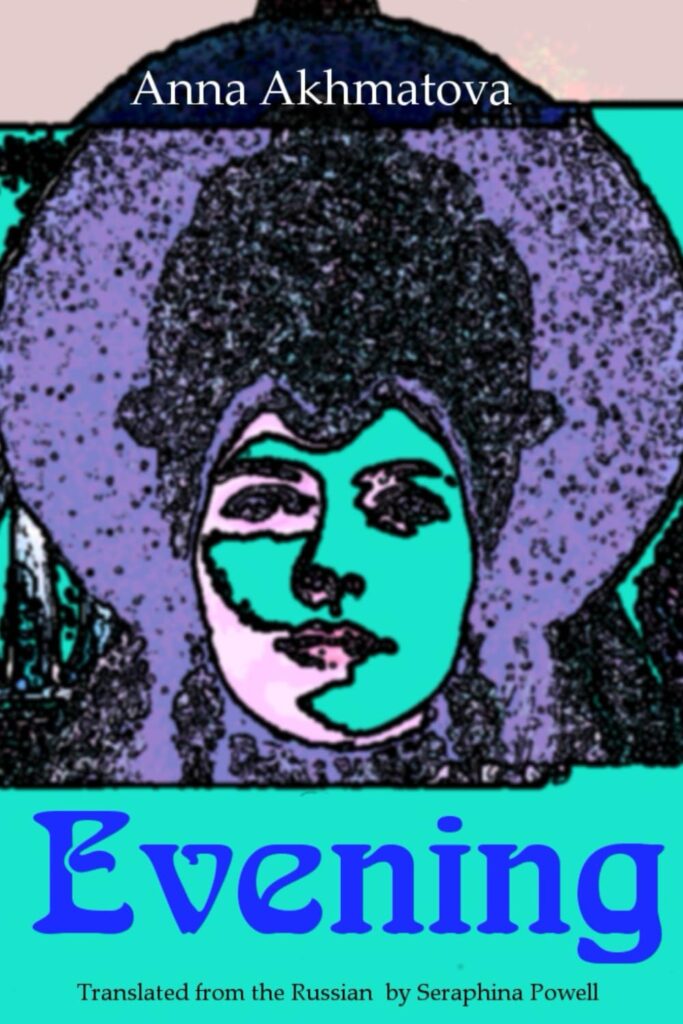
Anna Akhmatova: Evening, Rosary; Seraphina Powell translator.
The most valuable insights offered by Harrington, regarding Akhmatova’s cinematic montage style, psychological-novel content, and elliptical style, were independently noted by Powell in the prefaces to her translations.
We needn’t show here how far Powell and Harrington agree, since Powell’s Akhmatova translations ready to hand, even now being serialized in this magazine
Here we will content ourselves with a few sample stanzas translated by Powell and other better known authors.
This opening stanza from a poem in Evening is translated by Stanley Kunitz, who knew no Russian, with the help of Max Hayward, who was fluent. Kunitz, who was America’s poet laureate twice (1974 and 2000) was certainly a gifted writer. But the idea that gussying up someone else’s translation is a meaningful way to interpret poetry is one I hesitate to endorse. Kunitz has,
Heart’s memory of sun grows fainter.
Sallow is the grass,
A few flakes toss in the wind
Scarcely, scarcely.
Jane Kenyon, likewise a distinguished poet, has,
The memory of sun weakens in my heart,
grass turns yellow,
wind blows the early flakes of snow
lightly, lightly.
Powell,
The memory of sunlight as something warm
fades from my heart.
The first frost has already yellowed
the green from the grass.
The wind is playing, just barely,
with a few flakes.
The points of agreement show what was actually written down. Powell has “connected the dots” in a way that makes the meaning accessible.

This is the opening of the famous poem about the Stray Dog Café. Donald Michael Thomas, the eminent British poet, translator and playwright, has,
We’re all drunkards here. Harlots.
Joylessly we’re stuck together.
On the walls, scarlet
Flowers, birds of a feather . . .
Judith Hemschemeyer, the translator most approved by academics,
We are all carousers and loose women here;
How unhappy we are together!
The flowers and birds on the wall
Yearn for the clouds.
Paul Schmidt, whose translation of Rimbaud is unsurpassed in English, has
All of us here are hookers and hustlers
We drink too much, and don’t care.
The walls are covered with birds and flowers
that have never seen sunshine or air.
Powell works into the poem an introductory stanza which makes it possible to understand what follows,
In the Stray Dog, a cellar café
on Petersburg’s Mikhailovsky Square,
an after-hours club where young artists and poets
celebrate their lack of celebrity—
“Nothing but a bunch of drunks and sluts!”
Yes, that would be us,
happily unhappy together.
To make up for the lack of a view
the walls have been painted
with sad, flat flowers and birds
that make the sky seem even more unreachable.
One needn’t go on. Comparisons odious—but only for those who suffer by them. They’re darned useful for the buyer of a book of translations.