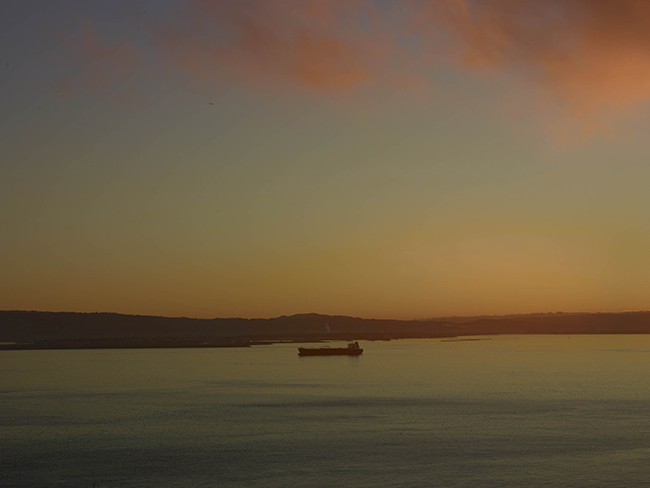
Richard Misrach, Cargo: December 17, 2021 7:27 AM
Momentum
Rothko’s color field paintings, vast abstract canvases of diffuse luminosity, are so strikingly like Richard Misrach’s signature images, that we may look to Rothko’s writings to better understand the latter.
Light had a special meaning for Rothko. As he saw it, light assumed its true importance in painting in the late Renaissance when oil paint came into use. In fast-drying, unforgiving fresco and tempera, forms could only be modeled by shape, shading, and perspective. But the advent of oil made it possible for images to be lit and not just bright. They could now be suffused with mood, as a scene on a stage is by colored lighting. Rothko thought that use of atmospheric light, first employed by Leonardo and the Venetian painters, could become, in the painted image, the missing link between interior and exterior reality.
Rothko felt he had gone beyond the Impressionists in this use of light, that he was making truly mythic, that is, existentially meaningful, visual narratives with light and color alone. His fields of color do indeed have an uncanny power. They seem to approach and recede, to possess an inner momentum. (Color all by itself can express motion, just as unmistakeably as one might suggest it by blurring, arrows, or figures in a sequence. A cool color like blue recedes into the background, a property well known to graphic designers who will place a warm toned image in front of a blue background to make it “pop.”)
Once we understand Rothko’s fields of color as narrative, Misrach’s skies reveal their implicit drama, like wide-screen scenes from David Lean’s Lawrence of Arabia—perhaps the aptest comparison for the photographer of the Desert Cantos.
The immensity of Rothko’s canvases was meant to allow the viewer’s immersion in the painting—he thought his largest works were best viewed from a foot away. Misrach’s Cargo photos are 60” x 80”. One can literally sink into these images that are as big as a queen size mattress.
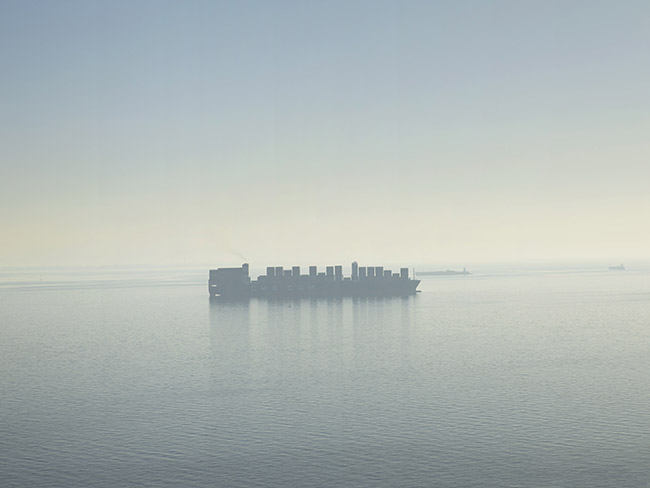
Richard Misrach, Cargo: December 16, 2023, 9:11 AM
Mono No Aware
The above image may evoke, at first glance, a Stonhenge floating on the ocean. But let’s not be too quick to dim our insights in Celtic twilight—there is more. The pale mists of the Cargo series, in their elegiac quality, hit the same plaintive notes as Emily Dickinson’s great meditation on the Summer’s end: the ephemeral sweet sadness implied in every twilight—
The dusk drew earlier in,
The morning foreign shone, —
A courteous, yet harrowing grace . . .
Misrach, like Dickinson, achieves a kind of Yankee mono no aware (the Japanese phrase means “gentle, wistful sadness at the transience of all things”):
And thus, without a wing,
Or service of a keel,
Our summer made her light escape
Into the beautiful.
Dickinson’s “service of a keel” recalls that ships in harbor are instrinsically symbolic of departure. The pastel sadness pictured here is a literal and figurative nostalgic look out over the Pacific, in the direction of old Japan.
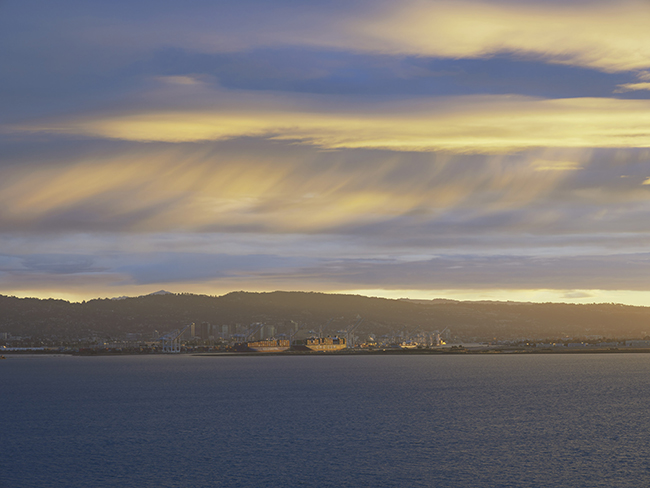
Richard Misrach, Cargo: Nov. 14, 2023, 6:56 AM
Wayfaring Saints
The Cargo series also evokes the plaintive poetry of the Arabian nomads, traders and raiders whose wares were carried by camels over seas of sand. Their world was made immortal in the Seven Odes—pre-Islamic poems, considered the foundational classics of Arabic poetry. The heroes of these delicate epics
. . . . navigate the pathless wastes;
tearful lovers part an hour before
daybreak and the breaking of camp,
when the dawn breeze is scented
by the clove trees in the oasis,
and camel dung punctuates the dunes
like peppercorns in a hill of salt . . .
The supreme Arabic poem is of course the Koran, born in Mecca, a city built on cargo, where the routes of merchants and nomads converged. Not for nothing does the Moslem calendar begin with the Hegira, Mohammad’s escape across the desert. Travel is as deeply woven into the Arabic sense of poetry as it is into a portable prayer-rug.
Only Islam could have produced the wandering dervish. According to the Koran, the world is full of numinous waymarks, signs, and leadings for the wayfaring saint. And since the Koran is one long Book of the Apocalypse, a 144 chapter warning of the impending Judgement Day, light is the supreme sign. The locus classicus is of course the twenty-fourth Surah, An-Nur (“Light”), which declares, “Allah is the light of heaven of earth . . . he guides whom he wills to his light, light given to mankind as the supreme metaphor. . . . “
It is no coincidence that Misrach’s first great photo-essay was devoted to the hippies of sixties San Francisco, spiritual seekers with the beards, beads, and voluntary poverty of saddhus, implausible followers of the Caravan of Summer, pursuing an illumination drugs appeared to offer, in psychedelic colors, unattainably past the horizon.
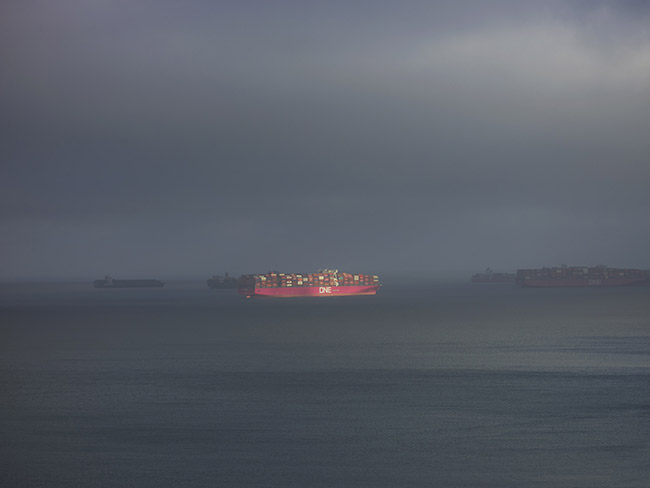
Richard Misrach, Cargo: May 14, 2021, 7:19 PM
Cargo Cult
As Pop Art should have taught us, products can be numinous. Every child who has marveled at a foreign stamp knows that any letter is potentially a message, a sending.
Mecca’s primary product is holiness. The haji who paints a Kaaba on the wall of his house exports it. The inhabitants of Araby the Blest aren’t shy about their traffic in the numinous; purveying, online and off, Zamzam water, Ajwah dates, attar, and prayer beads. Not only the pilgrim but the trinket has far-fetched blessings to bestow. Cargo “carries power,” as the Algonquin peoples put it.
The term “cargo cult” was first used by Norris Mervyn Bird, in a 1945 issue of Pacific Islands Monthly. It describes a phenomenon that arose in nineteenth-century Melanesia, when the indigenous people first encountered manufactured goods. Perhaps the phenomenon is best known from the 1980 film The Gods Must Be Crazy.
Typically, the belief arises that these marvelous items are being conveyed from the world beyond by tribal ancestors, as advance evidence of a coming golden age. Nowadays the term “cargo cult” is regarded with disfavor, because of its dismissive or patronizing overtones. The discomfort may be amplified by sympathetic awareness of the pain of culture shock, and perhaps even a little by embarassment at the parallel with Christian “prosperity theology.”
But this should not obscure the essential. The natives of Melanesia grasped the real and inalienable sacrality of “cargo;” it represents the essential generosity of Being.
Bringing our ethnography back to the coast that hosted Misrach’s vision, consider the potlatch, a gift-giving feast celebrated by the indigenous peoples of the Pacific North-West. This involved giving, and even destroying, wealth, to raise the prestige of the host and especially to maintain the human connection to the supernatural world.
Potlatch was made illegal in Canada by the 1884 Indian Act—not repealed until 1951. The missionary William Duncan wrote in 1875 that the potlatch was “by far the most formidable of all obstacles in the way of Indians becoming Christians or even civilized,” and Misrach has immortalized a modern gargantuan potlatch, still celebrated on our Pacific coast, in the image at the beginning of this section, where a cargo ship gleams like a magic Coke machine in a vast prairie of night. And again in the following image, where one would be hard put to tell a cargo from a cruise ship.
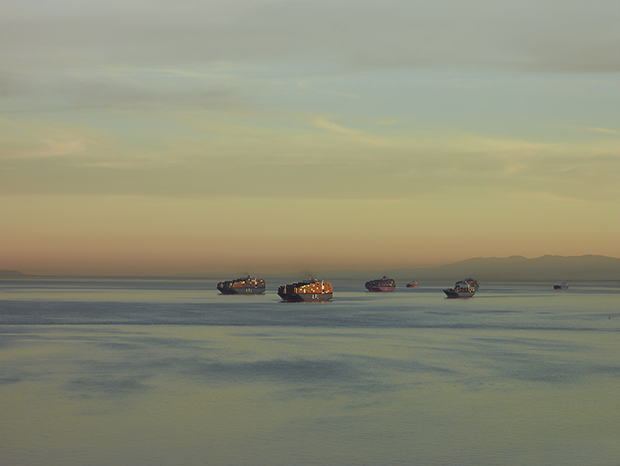
Richard Misrach, Cargo: January 11, 2022, 5:02 PM
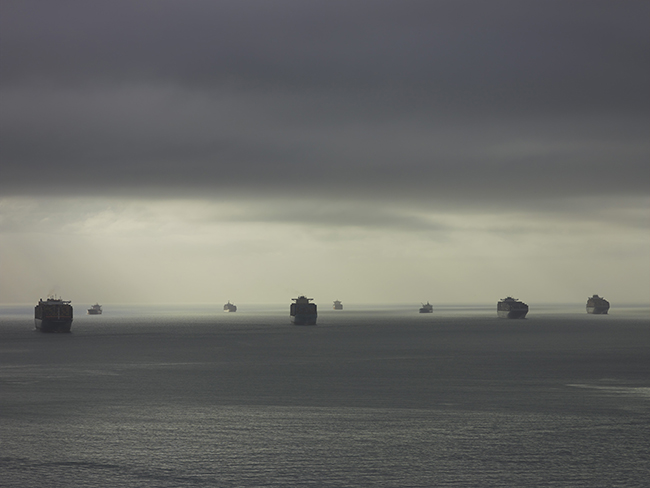
Richard Misrach, Cargo: March 4, 2022, 8:28 AM
Polluted Paradise
Misrach’s lifelong commitment to ecology, and his exquisite visual chronicling of America’s deserts devastated by industry, leaves no doubt as to the moral of his Cargo series. But the seas he shows us are as calm and magical as those in Shakespeare’s Tempest. In these pacific images, as in Shakespeare’s late romance, we can make out the shadows of tragedy, from political conspiracy to the moral ambiguity of the age of exploration. Like Shakespeare’s, Misrach’s “brave new world” doesn’t want for irony.
The dark clouds of these images are ambivalent. This is a polluted paradise. Mallarmé in his sky poem, L’Azur, saw the same a century and a half ago:
Industry’s chimneys smoke,
saddeningly ceaseless,
we carry with us our own prison of drifting soot,
strangling with horrible streaks
the yellow unhealthy sun
dying on the horizon.
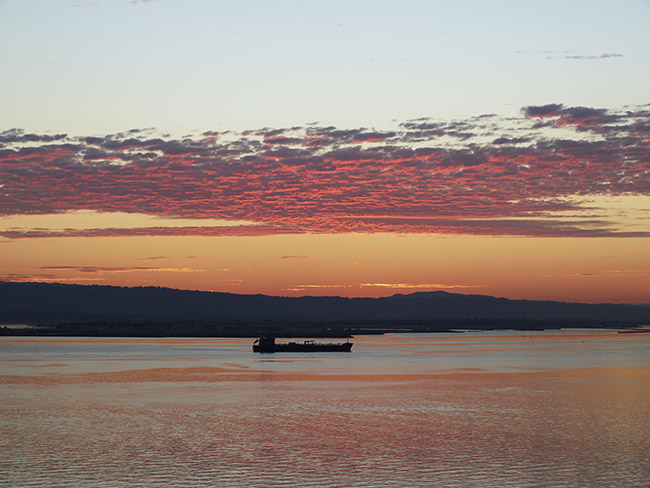
Richard Misrach, Cargo: October 6, 2024, 7:10 AM
Bittersweet is the luminosity here, very much like the spiritual, visual momentum of tragic, romantic Rothko. Misrach’s ships are ambivalent hieroglyphs of pilgrimage. The final lines of Mallarmé’s L’Azur, deepen our insight not only into the Cargo series, but into Misrach’s life-long meditation on the doomed beauty of our insulted wastelands:
Azure! Serene, eternal,
the atmospheric weight of its irony
crushes us with a lazy power
like that of a flower
—it needs only be
to defeat us. The poet curses his genius
that allows him to understand but not attain
such exaltation. Sky!
—so far above the deserts of our pain!