Akhmatova was born in 1899, well-educated, of a noble, land-owning family. Evening was published in 1912, when she was twenty-three. It inaugurated a new epoch in Russian poetry. Each poem condenses into a few lucid stanzas the emotional depth one might expect of a great psychological novel. Nothing like it had ever been seen, in Russia or elsewhere. It sold out edition after edition, and became the Bible of Russian lovers.
The book found many imitators among literary ladies. Told, “You have given Russian womankind a voice!” Akhmtova replied, “Yes, but now how do I get them to shut up?”
Akhmatova had a gift for depicting physical things in a way that carried psychological meaning. But she was not simply manufacturing metaphors. Her images have a photographic precision that makes them too concrete to be simply symbols. And they are not photographs, because they capture not a moment, but a narrative. They have a momentum. Akhmatova’s imagery is cinematic.
Powell’s complete translation of Evening is available for purchase here.
Part Two of Akhmatova’s Evening
Disloyal
I
On the terrace, a morning in spring ,
a morning drunk with sunlight
If the scent of roses were a thing one could hear,
you’d call it deafening,
and the sky’s more luminously blue than faience.
I read an album, bound in soft morocco,
my grandmother’s—in her day
gentlemen callers penned gallant stanzas,
love-lorn elegies, in just such books,
for girls whose French was flawless,
who played piano charmingly,
and had a pretty gift for watercolors.
From here I can see up the road
as far as the gate, the fence-posts are very
decidedly white against the turf’s
jewel-tone green. The flowerbeds are bright
in their dappled gladness. How sweet
is love, how rashly, without looking,
the heart pursues it! The sky clouds over
for a moment and a raven interjects
his gurgling croak. Down that woodland path
you can just make out a gravestone’s oval arc.
II
The wind holds its breath,
as if to let the day’s heat sink in.
All is motionless—a real “still life”—
as though the sky were a bell jar
of cobalt-blue glass
enclosing a Victorian
taxidermy nature display.
The woven-in flowers that haven’t yet
shaken loose from my braid yield a scent
as dusty as if they were dried.
On the fir tree’s rough gnarled trunk
is an ant-highway.
The distant pond glimmers
its dull, unambitious silver.
Who will be caught up into my dreams
today, as I nap through the heat
in my hammock’s multicolored net?
III
Azure evening. Late summer.
The wind is blowing gently now.
It’s still light late. The sky’s particular tint
of brightness now means I need to head home.
Who’ll be there? I’d guess my fiancé.
That is my fiancé, isn’t it?
Someone’s on the terrace, I recognize
his silhouette. Then comes a conversation
in hushed, low tones, then comes a captivating
languor such as I’ve never known.
The poplar trees rustle as though tender dreams
had made them tremble.
The sky has darkened to a steel blue,
a few pale stars appear.
I bring a little bunch of gillyflowers
for someone. The purple of their petals hints
at a fire repressed, unexpressed, but which he’ll touch
in the warmth of my palm as he takes
the blossoms from my hand,
my hand too timid to just reach out to his.
IV
I finally wrote him the words
I only had the courage to say in a letter.
My head vaguely aches,
and, weirdly, I feel everything less.
The last hunting horn of the season
has since sounded in the distance,
if it echoes still, it’s only in memory.
All that I felt for him baffles me now.
The first faint dusting of autumn snow
has fallen on the lawn where we played croquet.
Let the last late leaves on the poplar trees
have their rustle—I no longer listen to their whispers;
the old, tormenting ideas
are worn out with rethinking.
I’ll be happy. I won’t spoil
your oblivious, customary fun.
I’ve forgiven the cruel, joking words
I’m sure you don’t even recall having said.
The lips that spoke them are dear to me still.
After all, tomorrow, you’ll be here,
along with the first real snowfall.
They’ll light candles in the dining room,
more tender is their shimmer in the light of gray day.
On the table, they’ll set roses from the greenhouse,
like summer recovered, a whole great bouquet.
Paris, 1911: A Drunken Day with Modigliani
You’re so much fun when you’re drunk,
even though your stories don’t make any sense.
The elm trees’ leaves turned early:
autumn’s yellow pennants.
We’ve wandered into a wonderland
too seemingly real to be so.
We should feel terrible about it,
so what are we doing with these fixed, silly grins?
A little bitterness, please, for the sake of decency!
There’s no excuse for this placid happiness—
be that as it may, I won’t abandon you,
my tender drunken buddy.
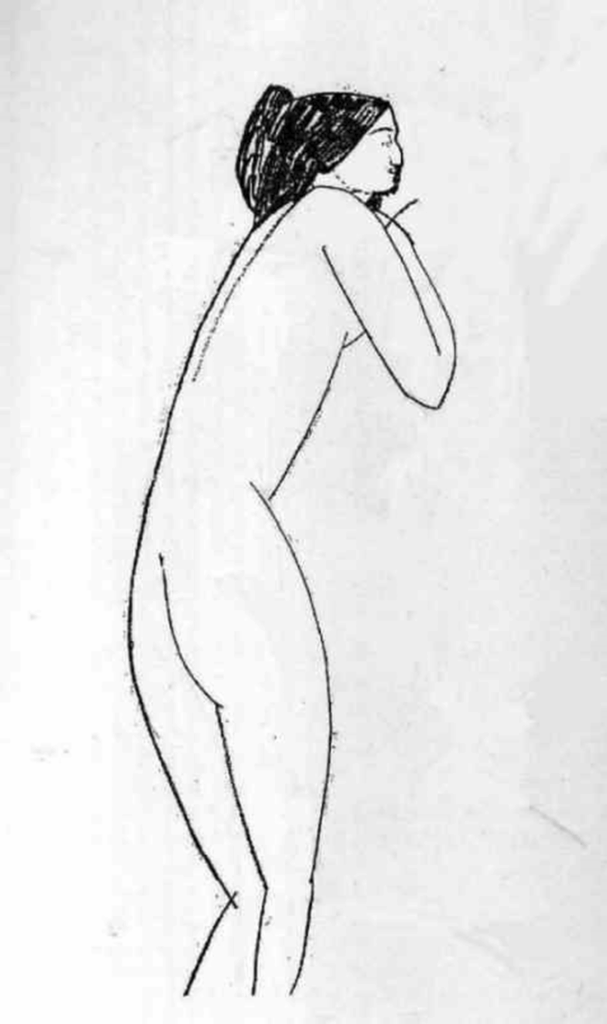
Modigliani, drawing of Akhmatova asleep, 1911. Public Domain.
My husband took that handsome, patterned belt . . .
My husband took that handsome, patterned belt of his,
folded it in two, and gave me quite a hiding.
I wait for you, peering through the little hinged window
that lets in a breath of winter
when the stove-warmed air inside gets oppressive.
All night I sit here, lamp in hand,
and it’s getting to be day. Smoke’s rising now
from the blacksmith’s chimney.
Again you couldn’t find the time
to stay a night with me, to cheer me
here in my miserable prison.
It’s for you I go on living, accept
my dreary, hurtful lot.
Did you find someone new? A blonde?
Or is she a redhead, your new girlfriend?
Even thinking this makes me groan out loud.
When the night’s too black, the eye can’t see;
when the air’s too close, you can’t even breathe;
this weight is more than my heart can take.
You couldn’t have made me feel more stupid
if you’d made me drunk. Morning’s rays
just touch the unrumpled bed
where no one slept.
Whatever it is that truly unites . . .
Whatever it is that truly unites
two hearts, it isn’t manacles.
So, go, if you want to. There’s happiness
a-plenty out there, ready for those
whose road is open, for the free.
I’m not crying. I’m not even complaining
that happiness just didn’t happen for me.
No, don’t kiss me. I’m tired.
When death comes, he can kiss me goodnight.
I’m exhausted. So sharp was the pain,
endless the days without you, and relentless
as the whiteness of winter.
Why oh why did you have to be
so much better than the man I chose?
On my knees at sunrise . . .
On my knees at sunrise in the vegetable patch,
humming a love song, yanking out goosefoot,
tossing the stalks: they’ve tiny clustered flowers,
velvet blue-gray leaves shaped amazingly
like real geese feet.
Forgive me, pretty weeds!
I look up: by the rustic fence
woven from branches and twigs,
a barefoot girl is crying.
Her high clear voice of painful fear
is harrowing. The scent
of the goosefoot’s murdered stems
gets more intense in the sun-warmed air.
“What man is there of you, who, if his son
ask bread, will he give him a stone?”
That’s the hard prize my deliberate deafness
will earn me. Above, there’s only cloudless sky,
and all I can hear is that little girl’s cry.
I wandered here, without meaning to . . .
I wandered here, without meaning to.
A girl with nothing to do,
I could just as well not do it here
by the motionless mill
on a sleepy little hillock.
I don’t need to say anything,
not now, maybe not ever.
It’s August, over a wilting morning glory
a bee swims gently through the air.
I salute the rusalka, the naiad of the mill pond—
the souls of girls who drown themselves
because of being jilted, because of cruel husbands,
or on account of unwelcome pregnancies—
girls for whom water seemed to offer
a less cruel solution—these become rusalki,
sometimes playful, sometimes dangerous,
nixies of fertility, strongest in spring—
but it seems the spirit mistress of this particular pond
has passed away.
A rust-colored slime
has overspread her waters, formerly wide,
now shallow and shrunk from a whole summer’s heat.
A moon glitters in the blue
above the yellow, flickering leaves
of the trembling aspen.
I notice everything now,
it all seems somehow new.
The humid wind through the trees
reeks of moisture. I’m silent, a part
of this soundless place, I’m ready
to cease being and return to you, earth,
to let my estranged nature be reabsorbed
into the strangeness of nature.
Night fell. I didn’t even lock the door . . .
Night fell. I didn’t even lock the door,
didn’t light a lamp;
you don’t know how exhausted I was,
how unable to accept
that there was nothing to be done
but go to bed—
so I watched the last red-yellow
summer sunset streaks expire in darkness
past the fir trees. You don’t know how drunk
I suddenly felt when I heard a voice
I thought was yours,
I understood then hellishly well
that I’d lost all.
Oh, how certain I’d been
you’d come back.
We shelter from the sun in a threshing barn . . .
We shelter from the sun in a threshing barn.
It’s empty, offers shade, but it’s hot here too.
I laugh while I cry in my heart for sheer frustration.
My old companion whispers,
“Don’t give in to gloom, we’re on our way to better!”
I don’t believe my ancient friend.
He’s laughable, a wretched, blind old man
who’s measured out his life, step by careful step,
every road he took was boring and long.
I hear my own voice ring out, shrill and brittle,
the voice of folk who don’t know what “happy” even means,
“Our packs our light, the atmosphere is heavy
with impending weather, tomorrow
we’ll be hungry in the rain.”
Hide me wind . . .
Hide me wind,
cover me with dead leaves
and dust from the road, let that be my burial.
No kin came. You, wind,
are the only living witness to my end.
Evening aimlessly approaches above;
along with cooler, easier, evening breeze,
the breath of the land at rest.
I was once as free as you, wind,
but that wasn’t enough—
I also wanted to live!
You see what that won me. Look at me; lone,
cold as the corpse I soon shall be,
a dying woman whose hands none will fold.
on my dead chest.
Come wind, cover my heart if you can,
bandage the dark hurt of it,
and let the night shroud me in its dark,
let darkness be my shroud.
Command the breeze to whisper a prayer—
the blue mist of evening soothes like a psalm—
easing my way, alone as I go
into my final dream.
Make the reeds roar, O autumn wind,
with sudden gusting,
a bitter fitful hymn
for all my vanished springs.
Believe it. This fever that weakens me . . .
Believe it. This fever that weakens me
like loss of blood, wasn’t caused by the sting
of a serpent’s poison tooth.
In a white and a wintry field,
on a white and wintry day,
I became a shy girl who tries to sing back love
in the voice of a little lost bird
There’s been no path back for a long time now,
every other road is closed,
my prince, my tsaryevich, is in his tall fortress,
his kremlin. Is there any way
I can trick him into loving me again?
I don’t know how. All I do know
is that life on this earth is a cheat.
No forgetting how he came to take his leave of me.
I didn’t cry. It was fate.
Now I cast nightly spells so he’ll dream of me.
My magic has no power.
That’s why he sleeps so easily,
troubled by nothing, and I’m out here
staring at his high barred gates—
or has a sirin perched above his bed,
a sirin, half-woman, half-bird,
with a tender expression in her shining eyes—
the sirin’s proper roost is that famous tree in Eden,
she’s only seen by happy people.
Who hears her song forgets all else.
Surely some such bird
has already taken my place,
and is singing my tsaryevich her siren song.