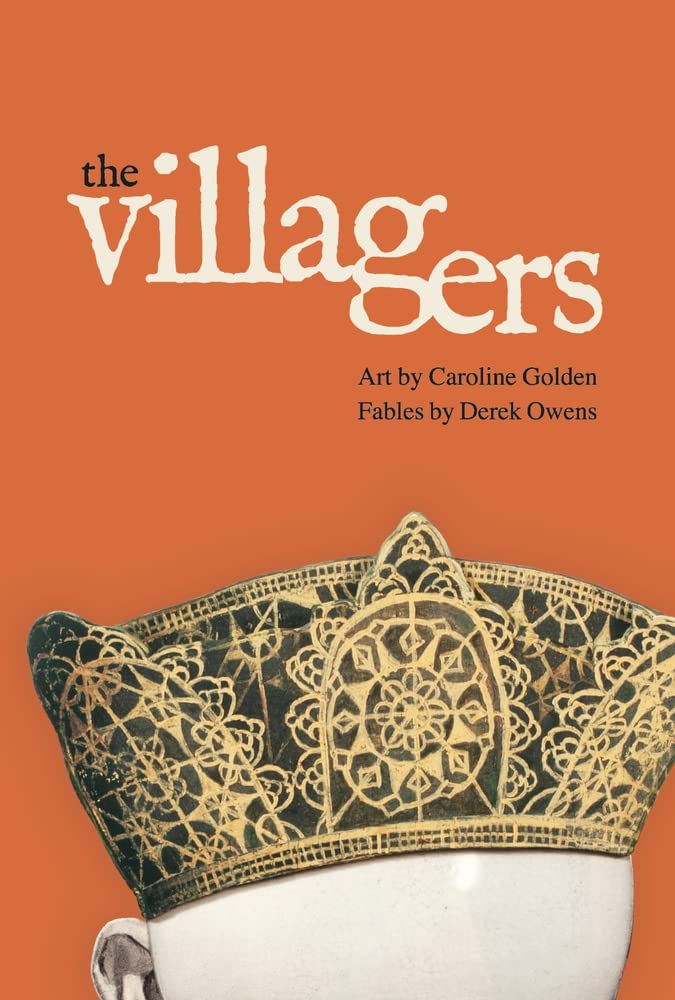
The Villagers
Derek Owens constitutes an intractable independency which you may find on the map of the imagination somewhere between the Duchy of Donald Barthelme and the Principality of Jorge Luis Borges. As is the case with Vatican City (its closest match in size and rare book holdings), the currency of Owens depends on the economics of belief. Geographically, Owens is less a riparian land than an outright lagoon, with a range of fauna that call to mind an earlier, more innocent, and less inhibited age of map ornamentation. Logical instability makes this a less safe destination for the casual visitor. It has long been regarded as a region of mystery, a reputation which this collection will do little to diminish.
One’s passage through these landscapes has been rendered yet more hallucinatory by the collages of Caroline Golden, who has done for Owens what Magritte did for Belgium. Her portrait-like images are at once cozy and disquieting, playful and grotesque, like a set of Toby Jugs acquired as souvenirs on a holiday in the world of the dead.
excerpt from the book
I spent every day until my appointment with the Caliph wandering aisles and alleys of the Kourosh Bazaar, the largest souq in the city, scouring the crowds. I had purchased a new set of crow-quill mapping pens just for the occasion, and after some searching was fortunate enough to procure a deliciously rich dark ink a crippled hag was selling, made from logwood extract, ground pitch burl, and charcoaled remnants from cremated ossuary remains. The tint had the same depth as raven feathers, so black it appeared blue in the sunlight. Page after page I filled with my scribblings, one for each subject, drying my impressions with powdered cuttlefish before concealing them in my satchel. What word will suffice? For I was not writing, nor dictating, nor drawing what I saw, but rather descrying, channeling my subjects while eye, hand, ink, and newfound abecedary collaborated autonomously and without conscious intervention. I spent hours at a time entranced, barely aware of my faculties, capturing humans of all stripes, children and the aged, free and slave, men and women, hale and infirm. In no time at all I had become fluent in how to read, translate, and set down the unspoken, unrealized, repressed, and yet all too visceral cravings, lusts, and yearnings housed deep, deep in the sub-basements of the people. Their hungers and appetites became more and more clear each day. These were not to be confused with the all too common psychoanalytical itches and buried wants discerned through customary analysis. No, what I discerned were primal urges locked in, unbeknownst to the humans within which they were trapped, and unreachable by any known arts of psychology. It was not my role to try and fully interpret my jottings, nor did I have the skills to do so; that would be a job for the Caliph’s assembly of clerics. Still, I felt something off-putting about my renderings, so much so that I was almost afraid to hold some of them. And yet, there was nothing overt within their content that I might pinpoint as to the source of my unease.